A capsule label can display a large milligram number without declaring how many grams of dietary fiber the serving supplies. The problem is not the unit. It is the category attached to it. Converting milligrams into grams changes the notation; it cannot change a blend into a measured nutrient.
This guide compares public labels checked September 26, 2026. It explains how to keep ingredient mass, proprietary blend mass, dietary fiber and soluble fiber separate. It does not judge a product’s effect from a number or calculate how much fiber an individual should take.
Write down the noun before the amount
Start with the exact heading beside a value. A psyllium husk amount describes that ingredient’s mass. A proprietary blend amount combines the ingredients listed under that blend. Dietary fiber is a nutrient declaration. Soluble fiber describes a component within the fiber information, when the manufacturer supplies it separately.
It is tempting to shorten all four to “fiber” in a shopping note. That shortcut makes unlike records look comparable. A more reliable note has four fields, even if several remain empty. Our amount translator follows that approach and puts the original serving basis beside the conversion rather than hiding it in a footnote.
Full House shows why the category matters
The Full House bottle image places 1,525mg beside a proprietary blend. Under it are konjac root extract, psyllium husk powder, glucomannan and apple cider vinegar powder. The image does not declare separate weights for those ingredients or a distinct dietary fiber quantity.
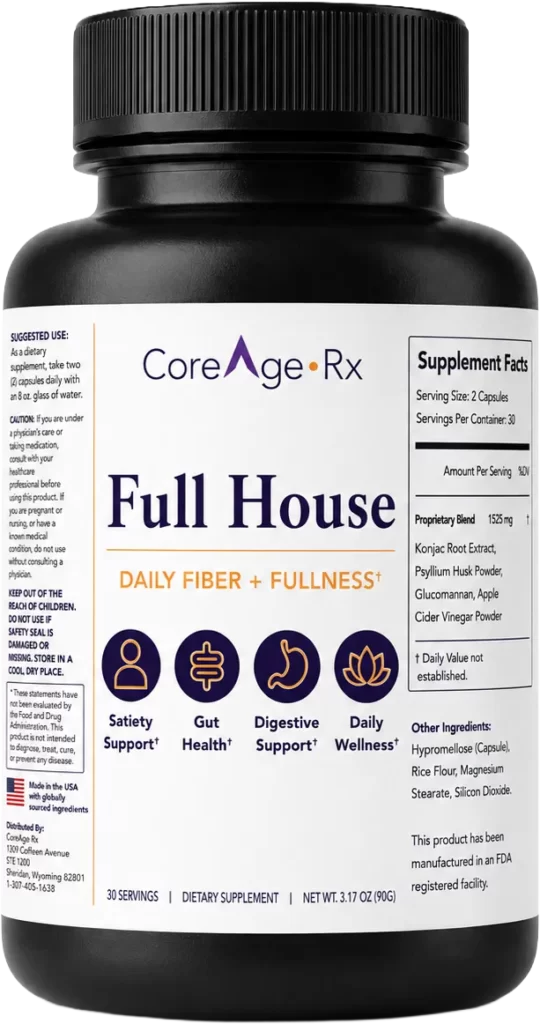
The arithmetic conversion is straightforward: 1,525mg equals 1.525g of that blend. It does not establish 1.525g of dietary fiber. Nor can the total be divided by four to create equal ingredient amounts; the label does not state that the ingredients are present equally. The Full House review explains how those omissions limit comparisons with ingredient research.
Konjac extract and glucomannan appearing as separate names also do not authorize double counting. A reader needs the manufacturer’s specifications to understand the particular ingredients and their contributions. Naming a plant and a fiber associated with that plant does not provide the missing measurements.
NOW provides two different totals
NOW’s panel lists 1.5g psyllium seed husk per three-capsule serving and 1.1g dietary fiber. It further breaks fiber into 1.0g soluble and 0.1g insoluble. The dietary fiber figure is therefore not simply the featured ingredient weight renamed.
That difference is useful evidence against assuming ingredient mass always equals dietary fiber. It does not tell us how to estimate a different product’s missing fiber amount. Applying NOW’s ratio to another formula would require assumptions about ingredients, composition and measurement that this review has not established. Read the NOW file for the rest of its label, including the sesame caution.
Solgar has matching numbers for different fields
The US Solgar page separately lists 1,000mg psyllium husk and 1g dietary fiber in a two-capsule serving. They match numerically after unit conversion. The fiber field is supported because it is explicitly declared, not because the numbers happen to agree.
That panel does not separately quantify soluble fiber. Leaving the soluble-fiber field unavailable is more accurate than copying the total dietary fiber value into it. The Solgar review retains this distinction along with the US product identity; a similar regional bottle is not an automatic source for a missing line.
A partial label calls for a partial answer
The Metamucil image retrieved for this edition has a readable 1.8g soluble-fiber statement, while the full facts panel curves out of clear view. We retain the readable statement and describe the rest as unverified. A missing transcription is not evidence that the nutrient is absent from the product.
This is a different situation from Full House’s visible panel, which does not separately declare dietary fiber in the image. Both lead to an unavailable comparison field, but for different reasons. Our Metamucil review identifies the image limitation so a reader knows that a clearer, matching label could resolve it.
Percent Daily Value is another kind of context
The FDA explains Daily Value as a labeling reference and %DV as the contribution from a serving. The fiber reference for adults and children aged four and older is 28g. That reference should not be used here as a personalized target or as a reason to convert a blend total into fiber percentage.
A printed percentage can also be rounded. Performing extra decimal calculations on a rounded label does not produce extra laboratory certainty. Keep the source precision visible, particularly when moving from a multi-capsule serving to one capsule. The serving-size guide shows how to handle that calculation responsibly.
Ingredient studies need more than a familiar name
The NIH supplement review discusses why multi-ingredient formulas and incompletely described amounts complicate the interpretation of weight-loss research. An ingredient appearing on a label does not establish the same preparation, amount, study population or outcome as a published trial.
Before comparing products, decide which field the question actually requires. If it requires a declared dietary fiber amount, seek that amount. If it requires an ingredient specification, ask for the specification. A reliable comparison can contain unknowns; the four-product shortlist keeps them visible so a cleaner-looking table does not become a less accurate one.
Sources for this file
Checked September 26, 2026. Access date is not a new clinical review date.
- Full House bottle label
Manufacturer / label image. Two capsules; 1,525mg proprietary blend. No separate dietary fiber amount or individual ingredient weights visible. Image inspected directly.
- NOW Psyllium Husk Caps 500mg
Manufacturer / US product and facts. TinyFish retrieved facts and $18.99 with 200 capsules / 66 servings. Direct automated browser was blocked. No checkout or shipping quote verified.
- Solgar Psyllium Husks Fiber 500mg Vegetable Capsules
Manufacturer / US product and facts. Two capsules; 1g dietary fiber and 1,000mg psyllium. 200-count UPC 033984023154. TinyFish and indexed manufacturer text retrieved; direct browser blocked. No US retailer price verified.
- FDA: Daily Value on Nutrition and Supplement Facts Labels
Regulator / label explanation. Daily Value and percentage context; adult and age-4+ dietary fiber reference is 28g. Not a personalized fiber prescription.
- NIH ODS: Dietary Supplements for Weight Loss
Public health / research summary. Glucomannan weight-loss findings are inconsistent. Ingredient studies and preparation-specific safety reports do not establish finished-blend results.